

Ever picked up a light bulb box and got stuck staring at a number like “800 lumens” with no clue what it means? You’re not alone. Most people grow up learning about watts, but lumens are actually the number that tells you how bright a light really is. In simple words, a lumen is the unit used to measure the total amount of visible light a source gives off. Understanding lumen meaning helps you buy the right bulb, set up better lighting at home, and stop guessing based on old habits. This guide breaks down the LUMEN Definition & Meaning in plain English, with examples you can actually use.
What Is a Lumen? (Simple Definition)
A lumen (lm) is the standard unit used to measure the amount of visible light emitted by a source, like a bulb, flashlight, or lamp. It tells you how much light you’re getting — not how much energy the bulb is using.
So when someone asks “what is a lumen”, the easiest answer is this: it’s the brightness number. The higher the lumen count, the brighter the light.
This is different from watts, which measure electrical power (energy used), not brightness. That mix-up is exactly why so many people misread bulb packaging for years.
Lumen vs Watt: What’s the Real Difference?
This is where most confusion happens, so let’s clear it up simply:
- Watt (W) = how much electricity the bulb uses
- Lumen (lm) = how much light the bulb actually produces
Old-style incandescent bulbs used a lot of watts to make a little light. LED bulbs use far fewer watts but still produce high lumens. That’s why “60-watt equivalent” LED bulbs exist — they’re telling you the lumen output, not the actual power draw.
Quick comparison:
| Brightness Level | Lumens (approx.) | Old Incandescent Equivalent |
|---|---|---|
| Dim (nightlight) | 200–300 lm | 25W |
| Soft light | 450 lm | 40W |
| Medium light | 800 lm | 60W |
| Bright light | 1,100 lm | 75W |
| Very bright | 1,600 lm | 100W |
Where Does the Word “Lumen” Come From?
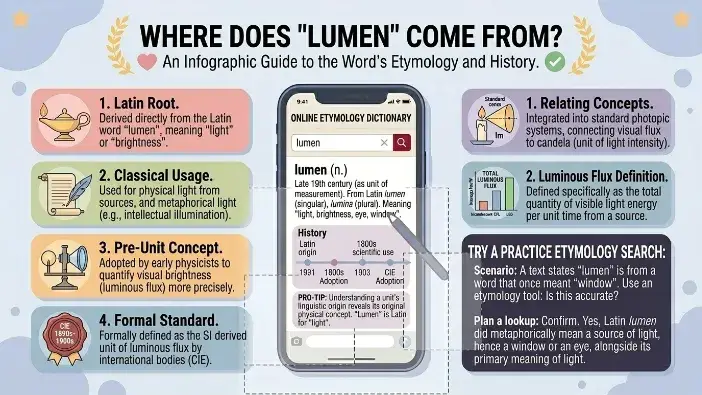
The lumen definition traces back to the Latin word lLUMEN Definition & Meaning “light” or “opening for light.” It’s also used in anatomy to describe the open space inside a tube-like body part, such as a blood vessel or intestine — but in everyday and technical use, lumen almost always refers to light measurement.
How Is a Lumen Measured?
Lumens are measured using an instrument called an integrating sphere, which captures all the light coming from a source in every direction and calculates the total visible output. Manufacturers use this to print an accurate lumen rating on packaging, which is regulated in most countries to prevent misleading brightness claims.
You don’t need the science to use the number, though — you just need to know that more lumens means more brightness, plain and simple.
Real-Life Examples of Lumen Meaning in Use
Understanding lumens becomes easy once you see it applied to daily situations:
- A small desk lamp usually gives around 400–500 lumens, enough for reading.
- A living room ceiling light often needs 1,500–3,000 lumens for full coverage.
- A basic phone flashlight produces around 20–50 lumens.
- A strong tactical flashlight can produce 1,000+ lumens for outdoor use.
- Kitchen task lighting works best around 3,000–4,000 lumens per room for clear visibility while cooking.
How to Choose the Right Lumens for a Room
Picking lighting isn’t just about grabbing the brightest bulb. Here’s a simple way to think about it:
- Measure your room size — bigger rooms need more total lumens.
- Decide the room’s purpose — bedrooms need softer light (lower lumens), kitchens need brighter light (higher lumens).
- Add up lumens, not bulbs — if you’re using multiple bulbs, divide the total lumens needed across them.
- Check the color temperature too — lumens tell you brightness, but Kelvin (K) tells you warmth or coolness of the light.
A simple rule many electricians use: multiply your room’s square footage by 20 lumens for general living spaces, and by 30–40 lumens for task-focused spaces like kitchens or home offices.
Tips to Avoid Common Lumen Mistakes

- Don’t rely on old wattage habits — always check the lumen number on the box.
- Don’t assume “bright white” packaging means high lumens — check the actual figure.
- Don’t ignore beam angle for flashlights and spotlights; the same lumens can look very different depending on how focused the light is.
- Don’t overlook efficiency — a good LED can produce more lumens per watt than older bulbs, saving money over time.
FAQs About Lumen Meaning
What does lumen mean in simple words?
A lumen is the unit used to measure how bright a light source is. More lumens means more visible brightness.
Is a higher lumen better?
Not always — it depends on the room and purpose. A bedroom needs fewer lumens than a garage or workspace.
How many lumens equal a 60-watt bulb?
Around 800 lumens is roughly equal to the brightness of an old 60-watt incandescent bulb.
What is a lumen used to measure besides light bulbs?
Lumens are also used to measure the brightness of flashlights, projectors, phone screens, and car headlights.
Is lumen the same as lux?
No. Lumens measure total light output from a source, while lux measures how much of that light actually lands on a specific surface area.
Why did lumens replace watts on packaging?
Because watts measure energy use, not brightness. As LED technology reduced power use while keeping bulbs bright, lumens became the more accurate brightness label.
Conclusion
At its core, lumen meaning comes down to one simple idea: it tells you how bright a light really is, not how much power it burns. Once you understand this, buying bulbs, choosing flashlights, or lighting up a room becomes a lot less confusing — and a lot more accurate. Next time you’re standing in the lighting aisle, skip the watts and look for the lumens instead. It’s the number that actually matters.
