If you’ve watched Severance on Apple TV+, one word keeps coming up again and again — Lumon. It’s the name of the mysterious corporation at the center of the show, but it’s more than just a brand name. The meaning of Lumon runs deeper than most people realize. Whether you’re searching for what is the meaning of Lumon in Severance, trying to understand what Lumon is about, or simply curious about why it’s called Lumon — this article answers all of that clearly and simply. We’ll also dive into the word’s linguistic origins, its emotional weight, and why Mark Scout’s connection to Lumon Industries is the beating heart of the entire story.
What Is Lumon? The Simple Answer
At its most basic level, Lumon is the name of the fictional biotechnology company in the Apple TV+ show Severance. Lumon Industries is the employer of the main characters — a corporation so controlling, so secretive, and so morally complex that it functions almost like a character itself.
But the name isn’t random. It was chosen deliberately — and once you understand the origin of the word Lumon, the show takes on a whole new layer of meaning.
What Is the Origin of the Word Lumon?
The word Lumon is derived from the Latin and Old French roots connected to lumen — meaning light.
- Lumen (Latin): unit of light; also means “opening” or “light of day”
- Lúmenes (Spanish plural): multiple units of light
- Lumon: a stylized, corporate form of lumen, suggesting illumination, clarity, and revelation
In scientific terms, a lumen measures how much visible light a source emits. It’s a real unit used in physics and lighting technology. When Lumon Industries adopted this name, it was projecting an image of a company that brings light — that illuminates the darkness, that enlightens its workers and the world.
The cruel irony? Lumon Industries does the exact opposite. It hides information. It separates people from their own memories. It controls what its employees can and cannot know about themselves. The name is a lie dressed up as a promise — and that’s precisely the point.
What Is the Meaning of Lumon in Severance?

The meaning of Lumon in Severance operates on multiple levels — literal, symbolic, and emotional.
1. Lumon as a Symbol of False Light
The Latin root lumen means light — but Lumon Industries offers a manufactured, controlled kind of “light.” Workers on the severed floor exist in artificially lit offices with no windows. They have no idea what time it is, what the world outside looks like, or even who they are in their outer lives. Lumon promises clarity and purpose, but delivers only carefully curated illusions.
This is Severance’s sharpest critique: institutions that claim to illuminate often exist to obscure.
2. Lumon as a Cult-Like Entity
Throughout the series, Lumon is portrayed with religious and cult-like qualities. There are portraits of the Eagan family — Lumon’s founders — displayed like saints. Employees are expected to follow the Lumon Lexicon and treat company doctrine with reverence. The founder, Kier Eagan, is spoken of with near-divine respect.
The name Lumon, in this context, echoes the language of spiritual enlightenment — a word religion and cults have long used to keep followers obedient and unquestioning. Lumon offers its workers a kind of false salvation: freedom from the burdens of real life, packaged as a gift.
3. Lumon as a Reflection of Real Corporate Culture
The show uses Lumon to satirize real-world corporate behavior — the wellness programs that mask exploitation, the team-building exercises that replace genuine human connection, the performance reviews that reduce human beings to productivity metrics. The word lumon, sounding clean and modern and vaguely technological, mirrors the polished branding of real-world tech giants who package surveillance and control in the language of innovation and care.
Why Is It Called Lumon? The Deeper Why
So why did the creators of Severance choose this specific name?
The answer lies in the show’s central theme: the tension between knowing and not knowing.
Light, in philosophy and literature, has always represented knowledge. To illuminate something is to understand it. To be in the dark is to be ignorant, lost, or controlled. By naming their corporation Lumon — a word that whispers light, clarity, revelation — the show’s writers set up an immediate and devastating irony.
The Lumon procedure (severance) is literally designed to prevent illumination. The innies (work-selves) cannot know their outside lives. The outies (personal-selves) cannot know their work lives. Both halves live in permanent shadow, even while working under the fluorescent glow of Lumon’s carefully maintained office floors.
It’s called Lumon because the name itself is the first lie the company tells — and possibly the most elegant one.
What Is Lumon About? The Story Behind the Corporation
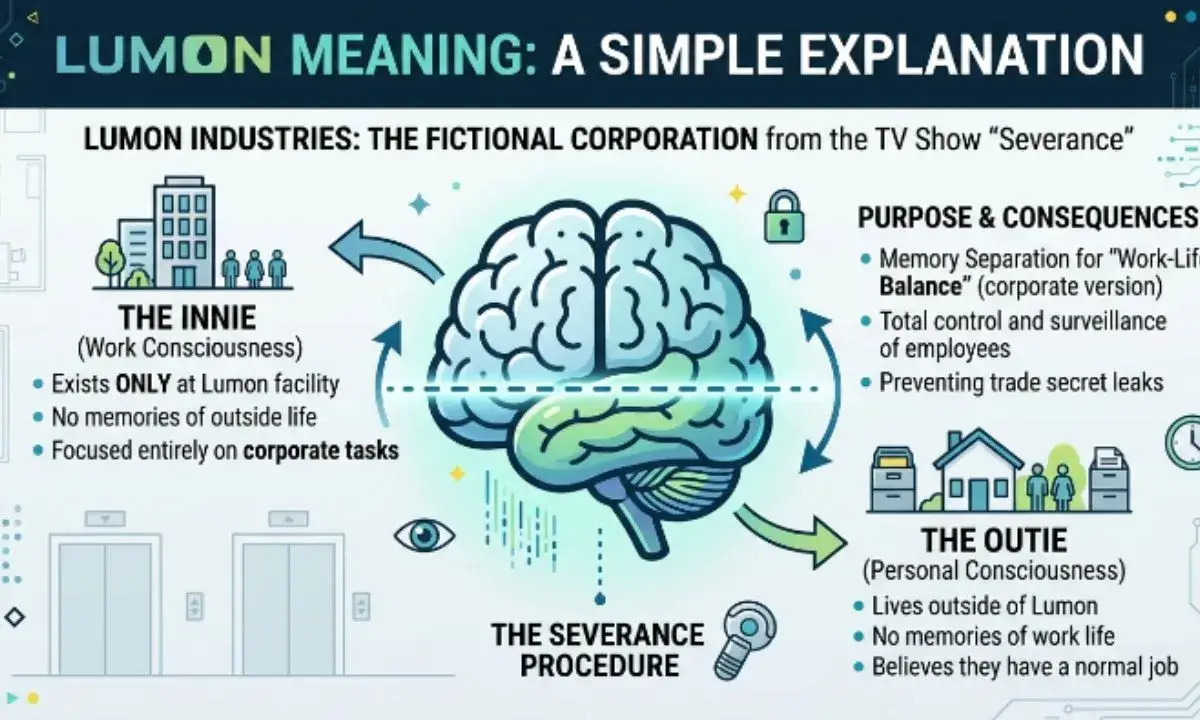
Lumon Industries, as depicted in Severance, is a biotechnology company that has developed a surgical procedure called severance — a process that creates a complete partition between a worker’s work memories and personal memories. When severed employees arrive at work, they have no memory of their life outside. When they go home, they have no memory of work. The two halves — called “innies” and “outies” — are essentially different people sharing one body.
On the surface, Lumon presents this as a gift: the perfect work-life balance. No stress from home bleeds into work. No stress from work bleeds into home. But the reality is far darker — Lumon uses severance as a mechanism of control, creating a class of workers who cannot resist, cannot report abuse, and cannot even fully consent to their own conditions.
What Lumon is about, thematically, is a meditation on autonomy, memory, identity, and the price of convenience. It asks: what are you willing to give up for the promise of peace?
Why Is Mark Important to Lumon?
Mark Scout (played by Adam Scott) is the central figure in Severance, and his importance to Lumon is both personal and institutional.
Mark as a Symbol of Lumon’s Ideal Employee
Mark chose severance voluntarily — to escape the grief of losing his wife. This makes him the perfect example of Lumon’s target demographic: people in pain who are desperate for relief. Lumon didn’t create his pain, but it did offer a product perfectly shaped to exploit it. Mark is important because he represents what Lumon sells: the idea that you can surgically remove suffering.
Mark as a Threat to Lumon’s Secrecy
As the show progresses, Mark’s innie begins to question, resist, and uncover fragments of the truth. His growing defiance — and the discovery that his dead wife Gemma is actually alive and working at Lumon under a different identity — transforms him from a compliant employee into an existential threat.
Mark as the Emotional Core
Mark is important to Lumon narratively because through him, viewers feel the full weight of what severance costs. His grief is real. His longing is real. And Lumon’s exploitation of that grief is the show’s most heartbreaking argument. He isn’t just a protagonist. He is proof of what happens when a corporation is amplely empowered to interfere with human consciousness.
The Word Lumon Beyond the Show: Language and Meaning
It’s worth noting that lumen and its derivatives appear across many languages and contexts:
- Lumen (Latin/English): unit of luminous flux; also means an opening or cavity in biology
- Lúmenes (Spanish): the plural of lumen, used in lighting specifications
- Illuminate: from lumen, to shed light on something
- Luminary: a person who inspires others; literally “a source of light”
- Luminous: glowing, radiating light
When you understand these connections, the name Lumon takes on even richer meaning. It’s not just a corporate name — it’s a word embedded in humanity’s oldest metaphors about knowledge, truth, and power.
In a way, to define Lumon is to define the show’s entire argument: light can be weaponized. Clarity can be faked. And the most dangerous institutions are the ones that promise to illuminate while keeping you permanently in the dark.
How to Write Your Own Analysis of a Symbolic Name
If you love breaking down the meaning behind fictional names or brands — whether for school, a blog, or just personal curiosity — here’s a simple method:
- Start with etymology. What language does the word come from? What does it literally mean?
- Look for irony. Does the word contradict what the thing actually does or represents?
- Find the thematic connection. How does the name tie into the central themes of the story?
- Consider the emotional resonance. What does the name make you feel before you even know the story?
- Connect to the real world. Does the name mirror anything in real corporations, history, or culture?
This framework works for Lumon, but also for names like Umbrella Corporation (Resident Evil), Cyberdyne Systems (Terminator), or Initech (Office Space).
Tips to Make Your Analysis More Personal and Insightful

- Trust your first reaction. What did you feel the moment you heard the name Lumon? That instinct is data.
- Research the creators’ intent. Dan Erickson (creator of Severance) has given interviews where he discusses themes — use those as anchors.
- Compare and contrast. The more you look at similar fictional corporations, the sharper your analysis becomes.
- Don’t over-define. The best symbolic names carry multiple meanings simultaneously. Resist the urge to flatten them into one explanation.
- Write as if you’re explaining to a friend. Clear, conversational analysis almost always beats academic stiffness.
FAQs About Lumon and Its Meaning
What is the meaning of Lumon in Severance? Lumon is derived from the Latin lumen, meaning light. In the show Severance, it’s the name of a fictional corporation that ironically suppresses knowledge and memory, despite the name’s connotations of illumination and clarity.
What is Lumon about? Lumon Industries is a biotechnology company that offers a surgical procedure called severance, which partitions a worker’s work memories from their personal memories. Thematically, the show uses Lumon to explore identity, autonomy, corporate control, and the ethics of memory.
Why is it called Lumon? The name comes from lumen, the Latin word for light. The irony is intentional — Lumon promises enlightenment and clarity but actually operates through secrecy, control, and the suppression of self-knowledge.
What is the origin of the word Lumon? Lumon is a stylized variation of lumen (Latin for light or opening), related to words like lúmenes (Spanish plural), luminous, and illuminate. It’s a word rooted in the human tradition of equating light with knowledge and truth.
Why is Mark important to Lumon? Mark Scout represents Lumon’s ideal product user — a grieving man who voluntarily gave up his memories for relief — and its greatest threat, as his growing resistance risks exposing the corporation’s darkest secrets, including that his deceased wife is alive and being held inside Lumon.
What is the difference between lumen and Lumon? Lumen is a real Latin word (and a scientific unit of light measurement). Lumon is a fictional corporate name derived from it, deliberately evoking light and clarity while representing the opposite in practice.
Conclusion
The meaning of Lumon is layered, deliberate, and quietly brilliant. On the surface, it’s just a company name. But once you trace it back to lumen — to light, to illumination, to the ancient human idea that knowledge is brightness and ignorance is darkness — the name becomes a thesis statement for the entire show.
Lumon promises light. It delivers shadow.
That tension — between what institutions claim to offer and what they actually do — is what makes Severance resonate so deeply. And it all starts with a single, carefully chosen word.
If you came here asking what is the meaning of Lumon, the real answer is this: it means exactly the opposite of what it says — and that’s the whole point.
